
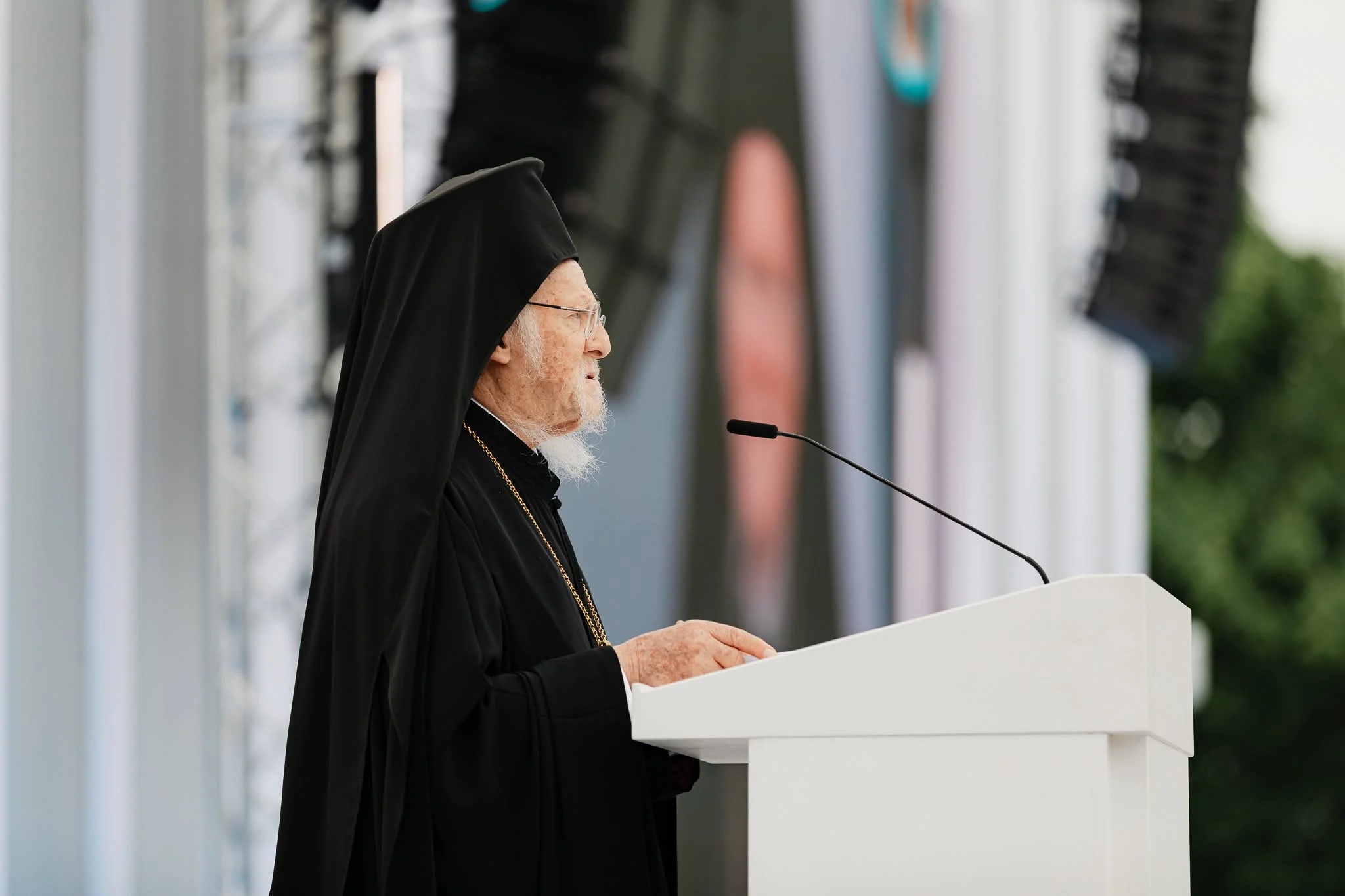
H Α.Θ. Παναγιότης ο Οικουμενικός Πατριάρχης κ.κ. Βαρθολομαίος, το πρωί της Δευτέρας, 8 Ιουνίου, συνεχίζοντας την επίσκεψή του στην Λιθουανία, εκφώνησε επίσημη ομιλία στις εργασίες του Παγκοσμίου Αποστολικού Συνεδρίου περί Ελέους της ΡΚαθολικής Εκκλησίας, κατόπιν προσκλήσεως του Σεβ. ΡΚαθολικού Αρχιεπισκόπου Βίλνιους κ. Gintaras Grušas, Προέδρου του Συμβουλίου των ΡΚ Επισκοπικών Συνελεύσεων της Ευρώπης.
Στην ομιλία του, με τίτλο «Οικουμενισμός και Έλεος – Υπερβαίνοντας την ιστορική αδράνεια», ο Παναγιώτατος αναφέρθηκε στην μεγάλη ευθύνη και σημασία της προώθησης του διαχριστιανικού διαλόγου, αλλά και της επίδρασης που έχει η ιστορική μνήμη στην κατεύθυνση αυτή.
«Το βάρος της ποιμαντικής, που έχουμε επωμιστεί σε μια εποχή ρευστότητας, μας αναγκάζει, παρόλο που οι διοικητικές προκλήσεις της καθημερινότητας συχνά αποσπούν το βλέμμα μας, να κοιτάξουμε το γεγονός της διαίρεσης κατάματα. Η επιμονή στην θεσμική απομόνωση ισοδυναμεί με άρνηση της αλήθειας ότι ο ίδιος ο Θεός αποκαλύπτεται ως κοινωνία τριών προσώπων. Ακυρώνουμε στην πράξη την πίστη μας στον Τριαδικό Θεό, αρνούμενοι την κοινωνία με τον αδελφό μας. Όταν οι άνθρωποι βλέπουν την Εκκλησία να κηρύττει θεωρητικά τη συμφιλίωση, ενώ η ίδια διασπάται καθημερινά από ενδοκοινοτικές διαμάχες, ο λόγος της απογυμνώνεται από κάθε ίχνος σωτηριολογικής πειστικότητας. Η επιμονή στη διατήρηση αυτών των διαχωριστικών τειχών εκδηλώνει μια βαθιά δυσπιστία απέναντι στην ανανεωτική δύναμη της Πεντηκοστής», επεσήμανε, μεταξύ άλλων, ο Παναγιώτατος, μιλώντας στην αγγλική γλώσσα, και σε άλλο σημείο της ομιλίας του είπε:
«Σήμερα, καλούμαστε να προσεγγίσουμε την ακανθώδη πραγματικότητα των διαχριστιανικών σχέσεων με πολύ συγκεκριμένο πνευματικό ρεαλισμό και συνοδική ευθύνη. Αυτή η διαδικασία αποτελεί ένα εξαιρετικά λεπτό ζήτημα, γεμάτο απαιτήσεις, επειδή ο θεολογικός διάλογος απαιτεί εξαντλητική εργασία από όσους συμμετέχουν. Πρέπει να διεισδύσουμε σε ένα δίκτυο ιστορικών διαφορών, πυκνό, πολλές φορές εντελώς αδιαπέραστο, για να αγγίξουμε το ίδιο το σώμα της αποκαλυφθείσας πίστης. Ακριβώς εκεί αναζητούμε τα πρωταρχικά νεύρα που συγκρατούν την ύπαρξη της Εκκλησίας. Η αντιπαράθεση με ένα τόσο βαρύ ιστορικό παρελθόν μάς επιβάλλει να αξιολογήσουμε αυστηρά το δογματικό μας οπλοστάσιο, απομονώνοντας τον ζωογόνο πυρήνα του Ευαγγελίου από τις ποικίλες ιστορικές μορφές που το περιέβαλλαν. Έτσι, αποκτούμε πλέον τη δυνατότητα να διαχειριστούμε τον διάλογο με όρους αυθεντικού ελέους.
Βιώνουμε πλέον ως καθημερινή πραγματικότητα μια εποχή που σφραγίζεται, σχεδόν τραυματικά, από την ψηφιακή απομόνωση και την προϊούσα κλιματική κατάρρευση. Ζούμε —και αυτό, πιστεύουμε, δεν απαιτεί ιδιαίτερη φιλοσοφική εμβάθυνση για να το δει κανείς— σε ένα τεχνολογικό τοπίο εντελώς ρευστό και απαιτητικό, όπου ο ίδιος ο αλγόριθμος των μέσων κοινωνικής δικτύωσης λειτουργεί με αποκλειστικό, ίσως, σκοπό την εμπορευματοποίηση της ανθρώπινης προσοχής, τροφοδοτούμενος αδιάκοπα από την πόλωση και μεγεθύνοντας, τεχνητά και μεθοδικά, την απόσταση μεταξύ των προσώπων. Αυτή η κυρίαρχη κουλτούρα της ακύρωσης ορθώνεται ως η πιο ανελέητη αντίθεση του ευαγγελικού ελέους. Δημιουργείται μια μνήμη που αρνείται να συγχωρήσει, που παίρνει το ανθρώπινο λάθος και το ψηφιοποιεί, μετατρέποντάς το σε αιώνια καταδίκη.

Η στάση του Οικουμενικού Πατριαρχείου καθορίζεται διαχρονικά από μια βαθιά οντολογική αυτοσυνειδησία. Η ημετέρα Μετριότης φέρει αυτή την αυτογνωσία ως υπέρτατο ποιμαντικό καθήκον προς τους Ορθοδόξους πιστούς. Με πλήρη αίσθηση ιστορικής ευθύνης, συμμετέχουμε ενεργά στους διμερείς και πολυμερείς θεολογικούς διαλόγους, καταθέτοντας διαρκώς τη ζωντανή μαρτυρία της ευχαριστιακής εμπειρίας της Ορθοδόξου Εκκλησίας. Στόχος παραμένει σταθερά η τελική αποκατάσταση της ενότητας εν ορθή πίστει και αγάπη. Παραμένουμε ταυτόχρονα αμετακίνητοι σε θέματα που αγγίζουν την ουσία του σωτηριώδους μηνύματος, γεγονός που η Αγία και Μεγάλη Σύνοδος της Ορθοδόξου Εκκλησίας το 2016 διεκήρυξε με απόλυτη θεολογική σαφήνεια. Η αδιάκοπη συμμετοχή μας πηγάζει κατευθείαν από την εσωτερική ανάγκη της Εκκλησίας να μεταδώσει τον αδιάθετο πλούτο της πατερικής της κληρονομιάς».
Ο Παναγιώτατος έκανε ιδιαίτερη αναφορά στους αοιδίμους Οικουμενικό Πατριάρχη Αθηναγόρα και Πάπα Παύλο Στ’ και στο θάρρος που επέδειξαν, τον Δεκέμβριο του 1965, όταν έλαβαν την γενναία, όπως την χαρακτήρισε, πρωτοβουλία της άρσης των αναθεμάτων του 1054. «Διέπραξαν το αδιανόητο, ανατρέποντας μια παγιωμένη αποξένωση εννέα ολόκληρων αιώνων. Το έλεος που επέδειξαν λειτούργησε ως ισχυρή δύναμη, η οποία διέρρηξε τα στεγανά της καχυποψίας»
Μετά την ομιλία του στο Συνέδριο, ο Οικουμενικός Πατριάρχης μετέβη στο Μέγαρο της Κυβερνήσεως όπου είχε συνάντηση, σε εγκάρδια ατμόσφαιρα, με την Πρωθυπουργό της Λιθουανίας κ. Inga Rugiene.
Το μεσημέρι, ο Παναγιώτατος, προσκληθείς από τον Πρόεδρο της Δημοκρατίας της Λιθουανίας κ. Gitanas Nauseda, παρεκάθησε σε γεύμα που παρετέθη στο Προεδρικό Μέγαρο.
Το βράδυ της ίδιας ημέρας, ο Πατριάρχης και η τιμία συνοδεία του αναχώρησαν αεροπορικώς για την Πόλη, στην οποία αφίχθησαν περί τα μεσάνυχτα. Στο Διεθνές Αεροδρόμιο του Βίλνιους τους προέπεμψαν ο Πατριαρχικός Έξαρχος Θεοφιλ. Επίσκοπος Ταμισού κ. Πανάρετος, ο Πρέσβης κ. Artūras Gailiunas, εκ μέρους του Υπουργείου Εξωτερικών της Λιθουανίας, ο Πρέσβης της Ελλάδος στην χώρα κ. Γρηγόριος Καραχάλιος, ο κ. Mehmet Bakici, στέλεχος της Τουρκικής Πρεσβείας εκ προσώπου της Πρέσβεως, και κληρικοί της Πατριαρχικής Εξαρχίας.
ECUMENICAL PATRIARCH BARTHOLOMEW: “ECUMENISM AND MERCY: OVERCOMING HISTORICAL INERTIA”, VILNIUS, 8 JUNE 2026
Your Eminence Gintaras Grušas, Archbishop of Vilnius, beloved brother in the Lord,
Your Eminences, Excellencies, Graces,
Reverend Fathers,
Esteemed audience,
Conveying the fraternal blessings of the Church of Constantinople, the Ecumenical Patriarchate, to all the participants of the World Apostolic Congress on Mercy, we have a duty, touching upon the agony of divided Christianity and traversing the centuries that accumulated successive wounds upon the body of the Church, to confront reality. If we excavate the historical subsoil, attempting to understand in the end the meaning of reconciliation, we perceive that the division of the Churches was produced chiefly by the transformation of theology itself into state ideology. Suffocatingly trapped was the message of salvation within geographical and political borders. Most frequently degraded is the concept of mercy, perhaps by an imperceptible but deeply rooted habit of the centuries, into a sentimental concession in the field of ecclesiastical geopolitics, into a diplomatic courtesy among hierarchs, losing entirely its radical character. The East and the West, at various historical junctures, required alterity exclusively to define their own identity.
Stabilising the rapture of communion throughout the centuries, Christian communities have elevated the wounds of the past into structural elements of their self-consciousness. Particularly the Orthodox, who bear indelible the suffering of the Capture of Constantinople in 1204 by the Crusaders, seem to be trapped within it, at the very same time that the West is absorbed in its own resentments. No one forgets those moments of history, during which ecclesiastical administration instrumentalised dogma, submitting to the seduction of secular power. Converting the redemptive word of the Gospel into an instrument of imposition, the weight of history seems to determine our contemporary ecumenical relations. Memory degrades into a sterile museum guardian of past grandeurs, when it is entrenched within the boundaries of self-preservation. Our ecumenical course suffers, visibly by now, from an inability to manage this internal wound.
Reducing our credibility before the nations that are torn daily by military conflicts, where geopolitical power annihilates human existence and societies collapse, peace sounds discordant, insofar as we ourselves are unable to heal our own, still bleeding, wounds. The stake of our common witness passes, inescapably, through the painful resignation from the acquisitions of a sterile confessional entrenchment. The transcendence which we expect demands a radical reversal of the way in which we perceive the very nature of unity. Watching the course of the Christian world, we perceive that the fear of alteration paralyses ecumenical initiatives, raising walls there where the Holy Spirit, potentially, traces new paths of approach.
If we view the division and ongoing estrangement of Christian communities without blinkers, we understand them to constitute a purely ontological dissonance within the design of the divine Economy. The burden of pastoring, which we have shouldered in an age of fluidity, forces us, even though daily administrative anxieties often distract our gaze, to look the fact of division squarely in the face. Persistence in institutional isolation is equivalent to a denial of the truth that God Himself is revealed as a communion of three persons. We invalidate in practice our faith in the Triune God, by denying communion with our brother. When people see the Church theoretically preaching reconciliation, while she herself is torn apart daily by intra-communal strife, her discourse is stripped of every trace of soteriological persuasiveness. The obstinacy in preserving these dividing walls manifests a deep distrust towards the renewing power of Pentecost.
The familiar repetition in our liturgical assemblies of the petition “Lord, have mercy” (Psalm 123:3), contains a staggering invocation for healing. The folk etymological affinity in Greek between the words “ἔλεος” (mercy) and “ἔλαιον” (oil), driven by how similar they sound and how they have been used together symbolically in the Orthodox Christian tradition, shifts the entire weight of human failure from guilt to illness. The whole ecclesial community supplicates that the medicinal oil be poured onto the open wound, that our body be healed. A descent into a theological abyss is required. There where our institutional certainties are crushed before the need for authentic existential kenosis, the pain of division must be experienced as a personal, bodily illness. Human reason ought to fall silent before the supreme mystery of the incarnation. St John Chrysostom, describing the magnitude of this intervention within the history of the fallen world, declares that “the reconciliation of God with men has been accomplished and the chronic war has been dissolved.” This very chronic war is rekindled with tragic consistency every time Christian confessions entrench themselves behind their historical privileges, allowing the passions of human inadequacy to dictate our stance, perpetuating hostility. Our refusal to transmit the peace-making message to our separated brothers is equivalent to hybris against the passion of the Cross. Preferred is the security of dogmatic borders over the impetus of the spirit of the Resurrection.
The time has come to leave behind the illusion of our historical innocence. This process, highly painful for our institutional ego, presupposes the conscious retreat of our collective self, so that the vital space of reception may be ensured. Examining the reluctance of ecclesial organisations to make this sacrificial move, one wonders how deeply rooted has become the conviction that the yielding of space means deterministically a loss of confessional identity. Constantly projected is the danger of altering traditions and sedulously avoided is the cruciform dimension of love. Our old wounds seem to have by now been transformed into our anatomical features.
Today, we are called to approach the thorny reality of inter-Christian relations with very specific spiritual realism and conciliar responsibility. This process constitutes an eminently delicate matter, full of demands, because theological dialogue requires exhaustive labour from those who participate. We need to penetrate into a network of historical differences, dense, many times entirely impenetrable, in order to touch the very body of the revealed faith. Exactly there we seek the primary nerves which hold together the existence of the Church. The confrontation with such a heavy historical past imposes that we strictly evaluate our doctrinal arsenal, isolating the life-giving core of the Gospel from the varied historical forms which surrounded it. Thus, we acquire henceforth the possibility to manage the dialogue with terms of authentic mercy.
We experience now as a daily reality an era that is stamped, almost traumatically, by digital isolation and the advancing climate collapse. We live —and this, we think, requires no particular philosophical deepening for one to see it— in a technological landscape entirely fluid and demanding, where the very algorithm of social media operates with the exclusive, perhaps, purpose of commercialising human attention, feeding ceaselessly on polarisation and magnifying, artificially and methodically, the distance between persons. This prevailing culture of cancellation comes to stand as the most merciless opposite of evangelical mercy. A memory is created that refuses to forgive, that takes human error and digitalises it, converting it into an eternal condemnation.
The stance of the Ecumenical Patriarchate is determined over time by a deep ontological self-awareness. Our Modesty bears this self-awareness as a supreme pastoral duty towards the Orthodox faithful. With a full sense of historical responsibility, we participate actively in the bilateral and multilateral theological dialogues, depositing constantly the living testimony of the eucharistic experience of the Orthodox Church. The goal remains steadily the final restoration of unity in the right faith and love. We remain at the same time unmoved in matters which touch the essence of the saving message, a fact which the Holy and Great Council of the Orthodox Church in 2016 declared with absolute theological clarity. Our unceasing participation springs directly from the inner need of the Church to transmit the unspent wealth of her patristic heritage.
The sole path toward the restoration of this authentic ecclesiastical ethos constitutes the purification of memory. Every hesitation of ours in this course deprives humanity of a critical paradigm of forgiveness. The credibility of the evangelical message in the contemporary fragmented world hangs from the ability of the Churches to prove that mercy possesses greater power than the preservation of the wound, which, when it is transformed into complacency, leaves behind it only ruins. Bearing the weight of this inheritance, we are called to transform the pain of division into a driving force of reconciliation, offering a word that wells up from the bowels of a crucified and resurrected love, that which dares to recognise in the face of the alienated brother the very presence of God.
Bringing back to our memory the brave initiative of the lifting of the anathemas of 1054 by the ever-memorable Ecumenical Patriarch Athenagoras and Pope Paul VI in December 1965, we recognise with awe the magnitude of their courage before the unbending circles of their Churches. They committed the unthinkable, overturning a consolidated alienation of nine whole centuries. The mercy they displayed acted as a dynamic force, rupturing the watertight compartments of suspicion. Looking forward to the fulfilment of the high priestly prayer of the Lord “That they all may be one” (John 17:21), they dared to look upon the face of the other without the dry rampart of a dogmatic complacency.
Similarly in our own era, we watch with satisfaction the shift of the centre of gravity in western theological thought, exactly as it was often expressed with particular boldness by the Bishop of Elder Rome. The elevation of the protection of our common home, as a new, peculiar work of mercy, opens up immense prospects. Prospects that offer a tangible space of encounter for all Christian denominations. Common action in favour of the environment, under the crying necessity of the times, becomes gradually a common, muddy lectern for Christianity, where the faithful read the needs of the world. Spiritual emptying demands our voluntary self-limitation for the sake of the survival of the whole, lending to the movement in favour of creation clear liturgical extensions. We bear the weight of this responsibility, seeing the credibility of the message hang from our ability to transcend the algorithms of polarisation.
Beloved brothers and sisters,
Standing before the immense challenges of our age, we cannot permit ourselves the luxury of ecclesiastical self-sufficiency. History weighs heavily upon us, yet the Gospel calls us beyond the captivity of history. Mercy is not a peripheral virtue, nor merely an emotional disposition; it is the very mode by which God enters the world and restores what has been fragmented. If we truly desire to offer a credible witness before humanity, we must allow mercy to become the principle of our ecclesial life, the criterion of our relations, and the horizon of our common pilgrimage.
The future of Christianity will not be secured by the preservation of inherited antagonisms, but by the courage to transform memory into reconciliation and suffering into communion. The wounds of division must no longer be guarded as sacred possessions, but entrusted to the healing grace of the Holy Spirit. Only then shall we discover anew that unity is not the triumph of one over another, but the common participation of all in the life of the Crucified and Risen Lord.
As we continue our journey, let us pray that the God of mercy may soften hardened hearts, illumine our minds, and strengthen our resolve to walk together in truth and love. In this way, our sister Churches may become once more a living sign of hope for a world exhausted by war, conflict and alienation, proclaiming not themselves but the boundless compassion of the Triune God, to whom belong all glory, honour, and worship, unto the ages of ages. Amen.